


OULI Classic (2018)
Quality metal plate ✧ Big Mural

OULI CLASSIC (2016)


No Borders Classic Version

Earth, Moon and the Universe

Earth and Universe Deep Field Extended Version
Buy Poster ✧ metal Plate
Acrylic Block
Other Products ✧ HD download

Solar rays eclipse, Earth and Universe


OTHER LANGUAGES

FRENCH (FRANÇAIS) ➢ Prints HD metal plate Other Products HD Download
GERMAN (DEUTSCHE) ➢Prints HD metal plate Other Products HD Download
SPANISH (ESPAÑOL) ➢ Prints HD metal plate Other Products HD Download
PORTUGUESE (PORTUGUÊS) ➢Prints HD metal plate Other Products HD Download
RUSSIAN (РУССКИЙ) ➢ Prints Other Products HD Download
ARABIC ➢ Prints Other Products HD Download
CHINESE ➢ Prints Other Products HD Download
JAPANESE ➢ Prints HD metal plate Other Products HD Download
HINDI ➢ Prints Other Products HD Download

Solar System and Our Galaxy


OULI 2023 (no text)

Rectangle Simple Version (2018)

Rectangle Complete Map Version (2024)

The Celestial Zoo Astronomical Fauna Explained (2023)

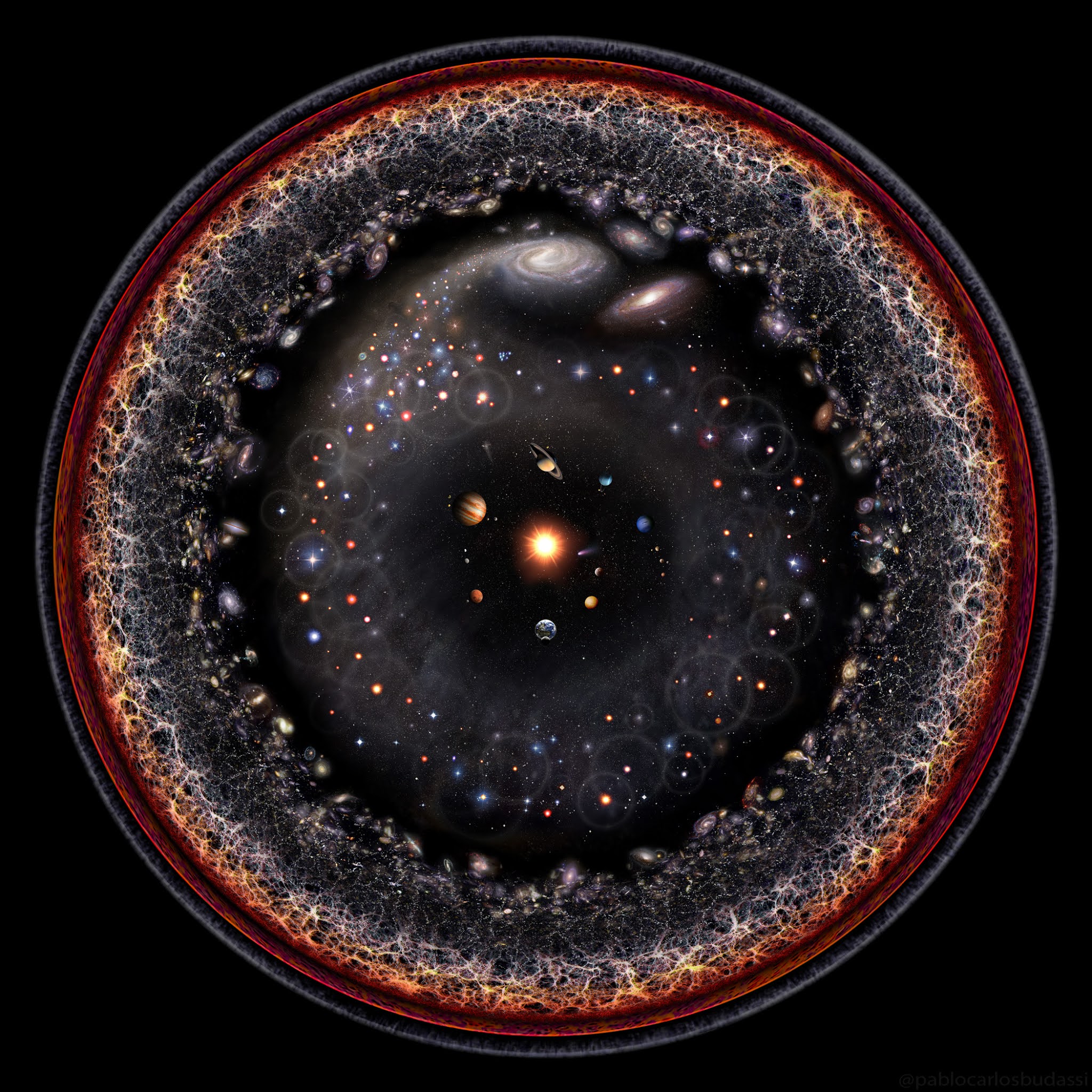
OULI Classic
Princeton’s Ugly Map and Budassi’s Beautiful One
In 2005, Princeton astronomers J. Richard Gott and Mario Jurić; used data from the Sloan Digital Sky Survey to produce a logarithmic map of the 93-billion-light-year observable universe and published it in the Astrophysical Journal. The map was accurate, comprehensive, and thoroughly ugly. Budassi’s contribution was not technical but aesthetic — and that aesthetic caught more attention than the science.
Gott and Jurić’s maps were scientifically valuable for understanding the structure of the universe. Assembled from the Sloan Digital Sky Survey’s 2.5-meter wide-angle telescope in New Mexico and covering spectral data for more than 3 million celestial objects, the work remains a cited reference in the scientific literature. But it had no visual appeal. Budassi took those maps as his foundation, colored them with imagery from NASA’s rovers and telescopes, and uploaded the result to Wikimedia Commons in 2013. He claimed no copyright — he released it into the public domain. The tradition of making celestial knowledge visually legible is not new: al-Jaghmini’s 13th-century astronomy manuscript was doing something similar — rendering the structure of the heavens in a form that could be held, studied, and passed on — seven centuries before Budassi opened Photoshop.
The image reached a wide audience in a wave of internet coverage at the end of 2015 and the beginning of 2016. Space.com, ScienceAlert, Business Insider, and dozens of other outlets ran the same image as a news story. Budassi’s name became more associated with this circle than with his music career. Within a few years it had become one of the most viewed science visuals on Wikimedia.
 This Image was selected as NASA’s Astronomy Picture of the Day on November 23, 2025!
it was also featured in Neil Degrasse Tyson’s 2023 book To Infinity and Beyond
