

VERY DETAILED SIDE VIEW OF “THE LOCAL GROUP” OF GALAXIES

A detailed lateral view of the Local Group of galaxies that contains the Milky Way, Andromeda, and other 120 minor galaxies. Expected future paths for major group members are denoted with arrows. The main map is accompanied by technical sheets for major galaxies, a top view, and a neighboring groups scheme.


The Andromeda Galaxy’s satellite system consists of Messier 32 (M32), Messier 110 (M110), NGC 147, NGC 185, Andromeda I (And I), And II, And III, And V, And VI (also known as Pegasus Dwarf Spheroidal or dSph), And VII (also known as Cassiopeia Dwarf), And VIII, And IX, And X, And XI, And XIX, And XXI and And XXII, plus several additional ultra-faint dwarf spheroidal galaxies.
It is unclear whether the Triangulum Galaxy (third-largest member) is a companion of Andromeda. The two galaxies are 750 kly apart, and experienced a close passage 2–4 billion years ago which triggered star formation across Andromeda’s disk. The Pisces Dwarf Galaxy is equidistant from Andromeda and Triangulum galaxies, so it may be a satellite of either. The membership of NGC 3109, with its companions Sextans A and the Antlia Dwarf Galaxy, is uncertain due to extreme distances from the center of the Local Group. The other members of the group are likely gravitationally secluded from these large subgroups.

Related works:
Panoramic Zoom Series
Local Sheet – Council of Giants – Local Group – Milky Way – Orion Spur

A wide-angle panoramic view of our cosmic address—perfect for your classroom or studio.


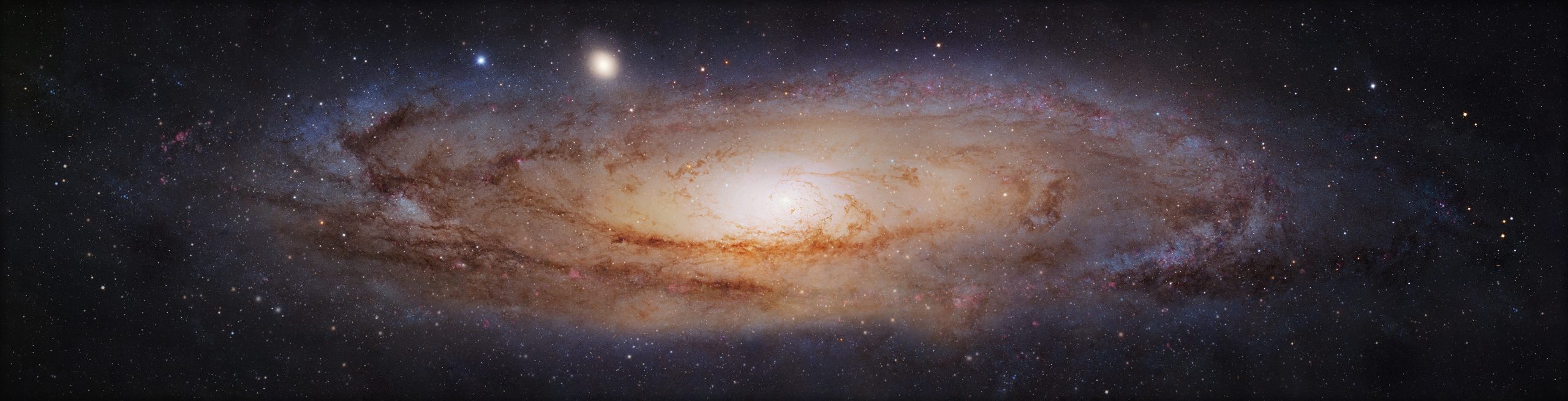
Hubble’s panoramic view of the Andromeda Galaxy
HD Print ✧ HD metal plates (panel 1 – panel 2 – panel 3) ✧ Other Products ✧ HD download
This is the largest photomosaic ever assembled from NASA/ESA Hubble Space Telescope observations. It presents a sweeping panoramic view of our neighboring Andromeda galaxy. Creating this vast and colorful portrait took more than a decade and required over 600 individual Hubble snapshots. The mosaic reveals the radiant glow of 300 million stars, spread across an astonishing 6.4 billion pixels. To complete the composition and depict the galaxy’s full disk, missing regions were filled with two public domain ground-based images captured by astronomers Kees Scherer and Stephen Rahn. The final panorama canvas is 50270 x 12850 pixels or 646 megapixels. Composite and processing by Pablo Carlos Budassi, November 2025.

Detailed diagram showing objects between the Earth and the Moon including artificial satellites, relevant sized near-Earth passing asteroids (past and future), and the different distances the Moon can take from Earth.
