
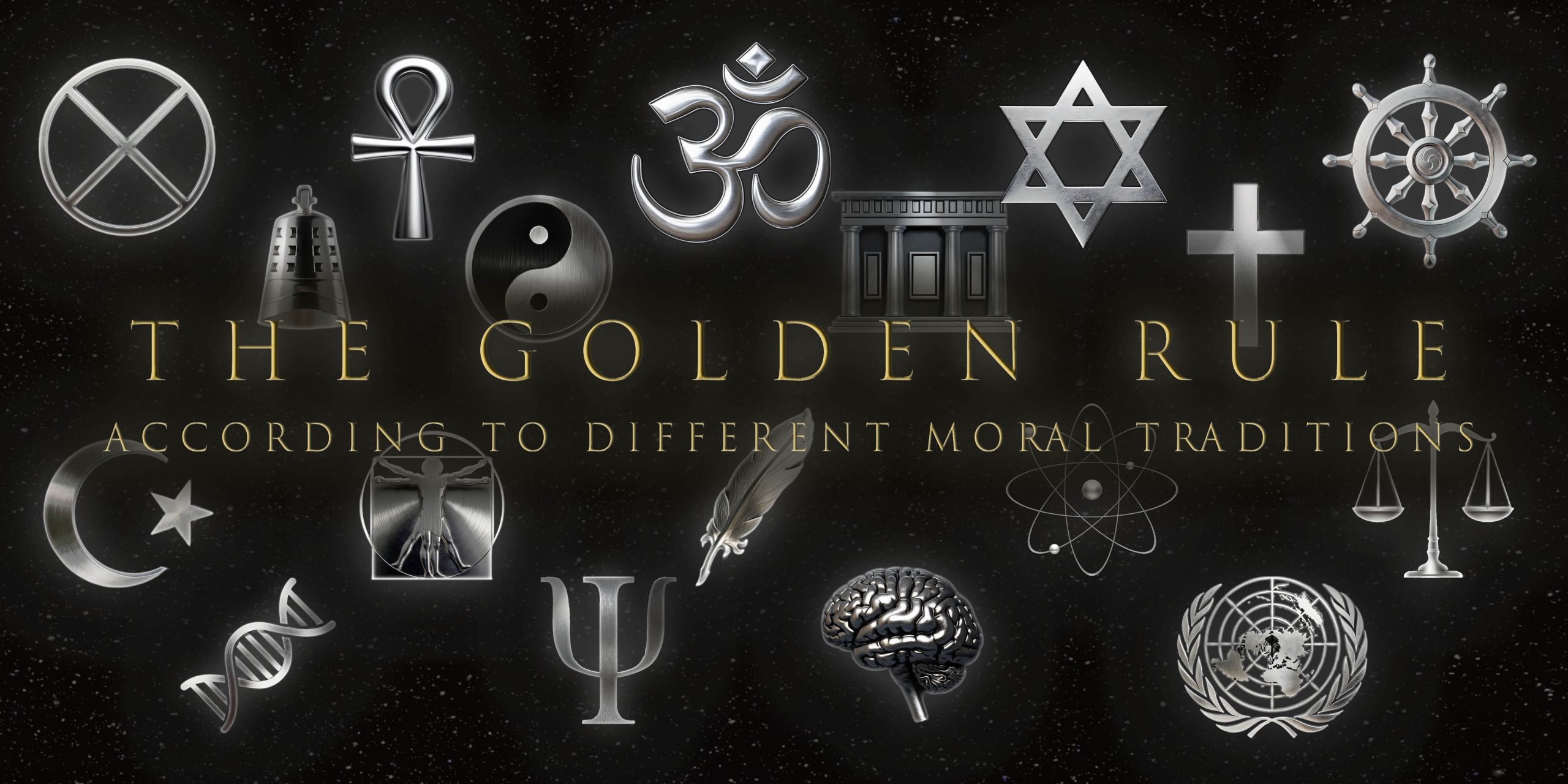
The Golden Rule is the principle of treating others as one would want to be treated by them. It is sometimes called an ethics of reciprocity, meaning that one should reciprocate to others how one would like them to treat the person (not necessarily how they actually treat them). Various expressions of this rule can be found in the tenets of most religions and creeds through the ages.

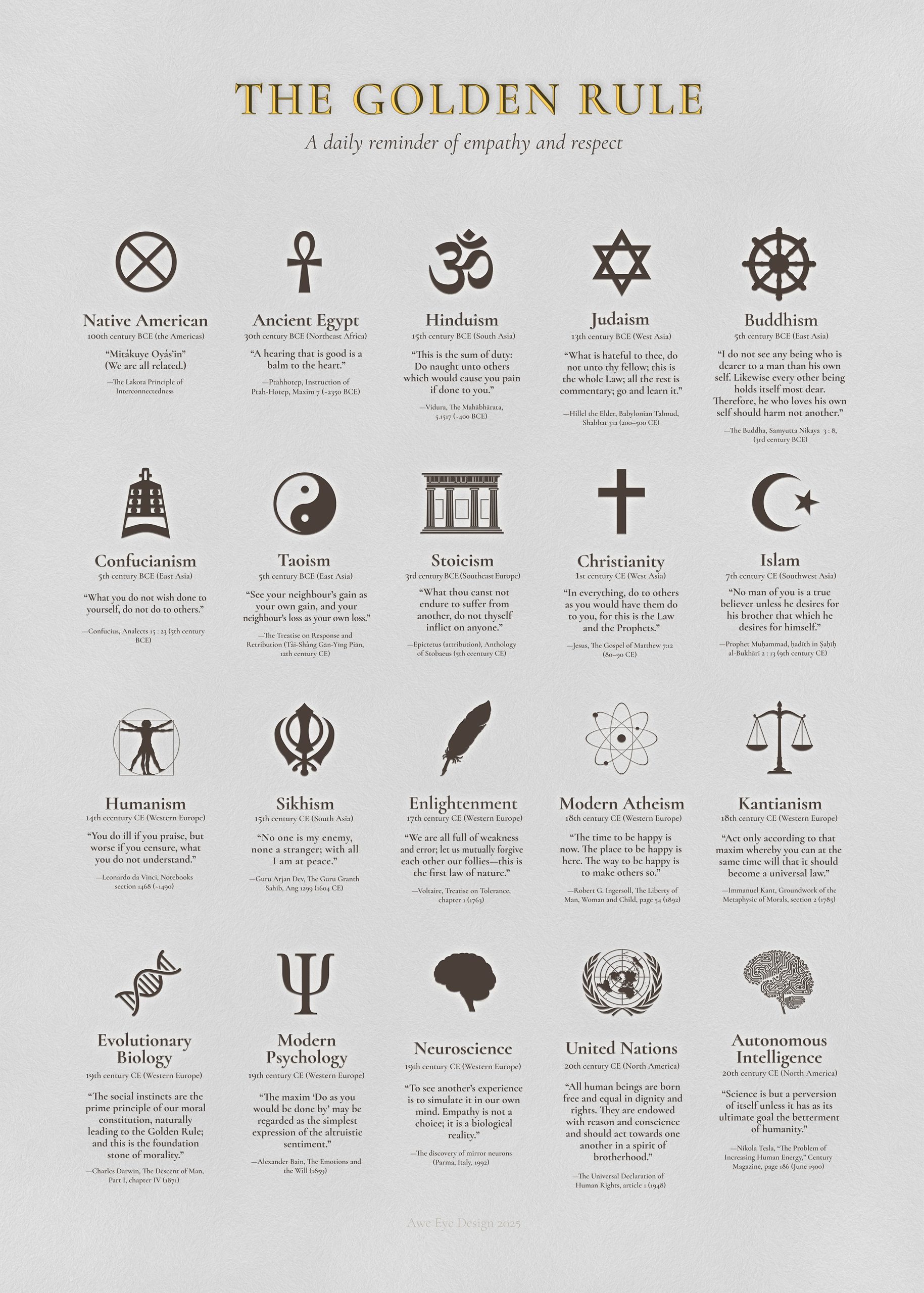
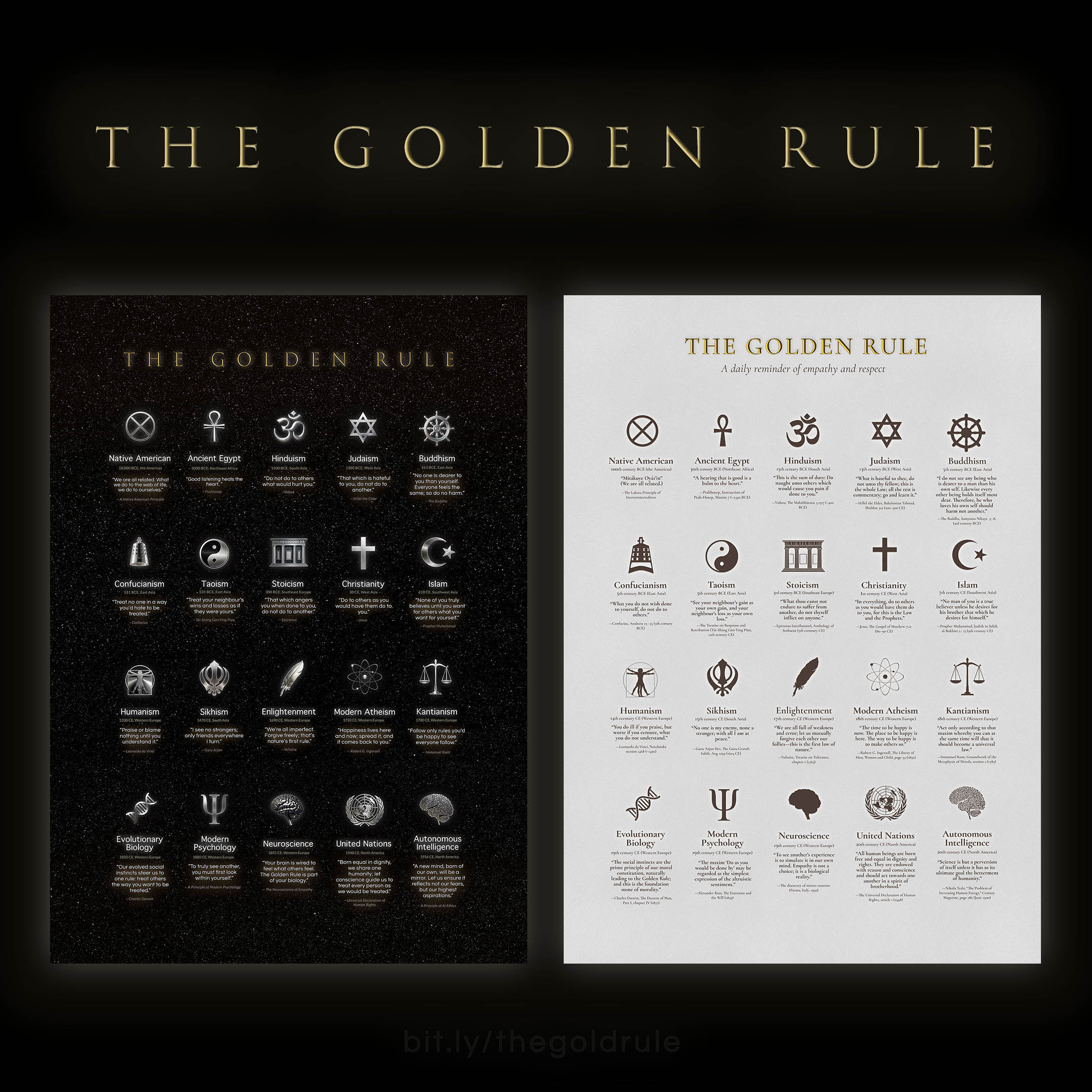
In this graphic, we present twenty expressions of the Golden Rule in chronological order. Each entry lists the tradition’s approximate date and region of origin, along with a representative quote and its author and source.
Starry Black: Buy Poster ✧ Quality Metal Plate ✧ T-shirt ✧ Other Products ✧ Download HD
Classic Beige: Buy Poster ✧ Quality Metal Plate ✧ Holographic Sticker ✧ Other Products ✧ Download HD
Full Color Icons: Buy Poster ✧ T-shirt ✧ Other Products
The maxim appear as a positive or negative injunction in different creeds:
- Treat others as one would like others to treat them (positive or directive form)
- Do not treat others in ways that one would not like to be treated (negative or prohibitive form)
- What one wishes upon others, they wish upon themselves (empathetic or responsive form)
Let’s break down each of the 20 expressions of the Golden Rule, tracing their origins and unpacking their meanings:
 Rooted in traditions that flowered as early as the 100th century BCE across the Americas, Native American worldviews enshrine reciprocity and kinship as their guiding ethos. Among the Lakota, this is captured by the enduring phrase Mitákuye Oyás’in (“We are all related”), uttered in prayer, council and ceremony to honor the interconnected web of humans, animals, plants and the land. This principle underpins the Seven Generations ethic—decisions made today must serve descendants seven generations hence—and finds expression in the Medicine Wheel’s balance of physical, mental, emotional and spiritual life. Beyond the Plains, echoes of Mitákuye Oyás’in appear in the Iroquois Great Law of Peace and Maya chac mool offerings, showing how many nations wove universal care into governance, ritual and art. The Lakota chant this Golden Rule at Sun Dances and Wiping the Tears ceremonies, reinforcing that justice, healing and gratitude flow best when we treat every being as a relative. By embracing Mitákuye Oyás’in, Native American cultures remind us that true reciprocity begins not with rules on paper but with honoring the shared dignity of all our relations.
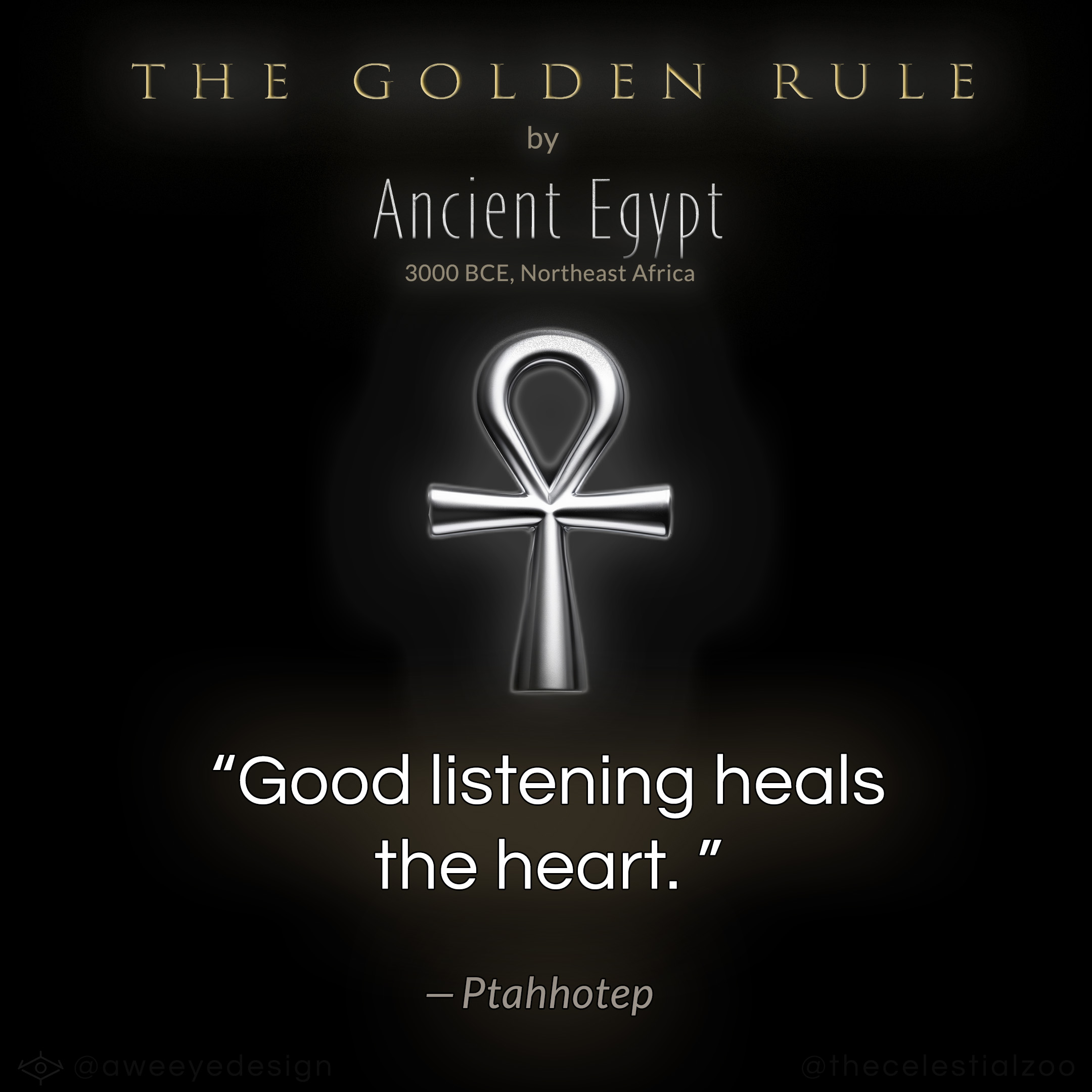
Arising in the 30th century BCE in Northeast Africa, Ancient Egypt wove reciprocity and attentive listening into its moral fabric. The proverb “A hearing that is good is a balm to the heart,” drawn from its rich wisdom literature, testifies to the idea that truly listening soothes conflict and sustains social harmony. Central to this ethos was the concept of Maat—truth, justice, and cosmic balance—which guided both private behavior and the Pharaoh’s duty to the people and the gods. From temple inscriptions recording gift exchanges to funerary rituals promising offerings for the afterlife, Egyptians treated every act of giving and hearing as part of a larger, sacred dialogue. By embedding the Golden Rule in daily life, monumental architecture, and scribal teachings, Ancient Egypt reminds us that empathy and respect are enduring foundations of a flourishing society.
 Emerging around the 15th century BCE in the Indus Valley (modern-day northwest India and Pakistan), early Vedic rites forged a moral fabric woven from dharma (duty) and ahimsa (non-harm). As Vidura admonishes in the Mahābhārata (5.1517, c. 400 BCE): “This is the sum of duty: Do naught unto others which would cause you pain if done to you.” This wisdom echoes through the Upanishads’ vision of all beings as one Brahman and in daily offerings of the first harvest to Agni, the fire god. From temple reliefs depicting Krishna’s compassion to pilgrim fairs where strangers share food and stories, Hinduism embeds reciprocity in festivals, caste-based duties, and pilgrimage circuits—reminding us that every act of kindness reverberates through the cosmic web of shared existence.
 Emerging in the 13th century BCE in ancient Canaan (modern Israel and Palestine), Judaism anchored communal life in a covenantal bond and legal tradition that prized empathy as much as ritual. Hillel the Elder distilled this ethos in Shabbat 31a of the Babylonian Talmud with his famous negative formulation: “What is hateful to thee, do not unto thy fellow; this is the whole Law; all the rest is commentary; go and learn it.” This terse silver rule reframes Leviticus 19:18’s injunction to love your neighbor, weaving personal conscience into every mitzvah—from hospitality shown to strangers to the prophets’ calls for social justice. The anecdote of Hillel patiently teaching a skeptical convert not only ensured the saying’s memorability but also cemented its place in synagogue inscriptions, rabbinic debate, and modern human-rights discourse.
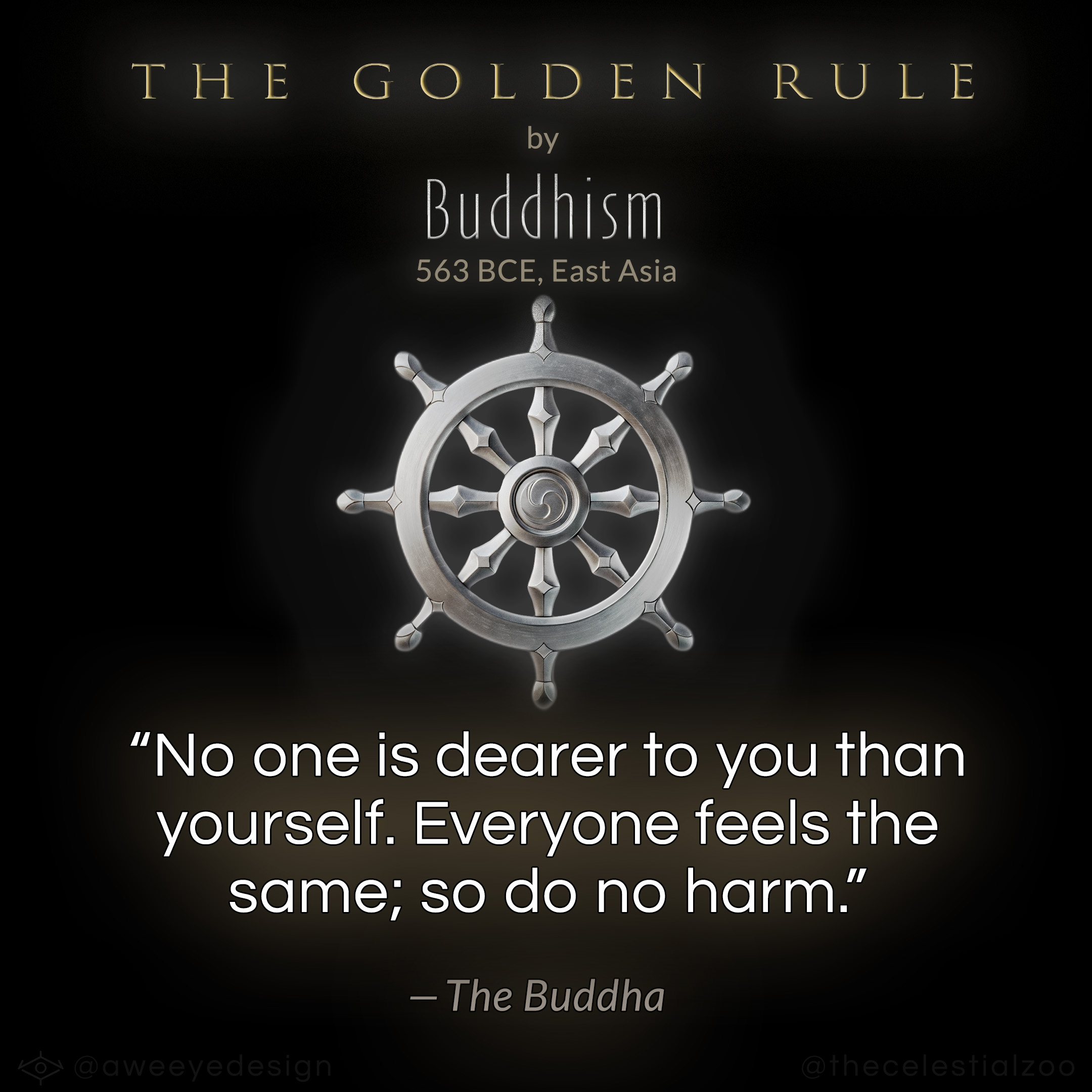 Emerging in the 5th century BCE in the Magadha region of the Indian subcontinent (present-day Bihar, India), Buddhism wove reciprocity into its very heart. As The Buddha teaches in the Samyutta Nikāya (3.8, 3rd century BCE): “I do not see any being who is dearer to a man than his own self… Therefore, he who loves his own self should harm not another.” This Golden Rule underpins the practices of metta (loving-kindness) and karuṇā (compassion), which are brought to life in the Jataka tales of self-sacrifice. In the 3rd century BCE, Emperor Ashoka echoed these precepts on his rock edicts, helping the ethic travel into East Asia. From monastic codes to modern mindfulness, Buddhism’s call to “harm not another” continues to guide ethical living worldwide.
 Emerging in the 5th century BCE in the State of Lu (modern Shandong Province, China), Confucianism wove reciprocity into the fabric of personal and public life. Confucius crystallized this in Analects 15 : 23—“What you do not wish done to yourself, do not do to others”—as the guiding principle of shu. Shu undergirds ren (humaneness) and li (ritual propriety), shaping family bonds through filial piety and steering rulers toward empathetic governance. Mencius later expanded on the idea of innate goodness and the role of shu in moral cultivation, while the imperial civil-service exams institutionalized Confucian reciprocity for over two millennia. Today, echoes of this Golden Rule persist across East Asia in everyday etiquette, community rituals, and educational values that emphasize respect, harmony, and mutual obligation.
 Emerging in the 5th century BCE in the Yellow River basin of ancient China (modern Henan Province), Taoism wove empathy into the cosmic order. The Treatise on Response and Retribution (Tài-Shàng Gān-Yīng Piān, 12th century CE) encapsulates its Golden Rule: “See your neighbour’s gain as your own gain, and your neighbour’s loss as your own loss.” Rooted in Laozi’s vision of the Dao as the unspoken Way, this ethic guided hermit sages practicing wu wei and villagers exchanging offerings in communal harmony. Later canonized in the Daoist Canon, the treatise inspired Song-era poets to praise mutual care and shaped East Asia’s ethos of shared reciprocity. By presenting empathy as a natural unfolding of the Tao, Taoism reminds us that treating others as ourselves mirrors the universe’s own balancing act.
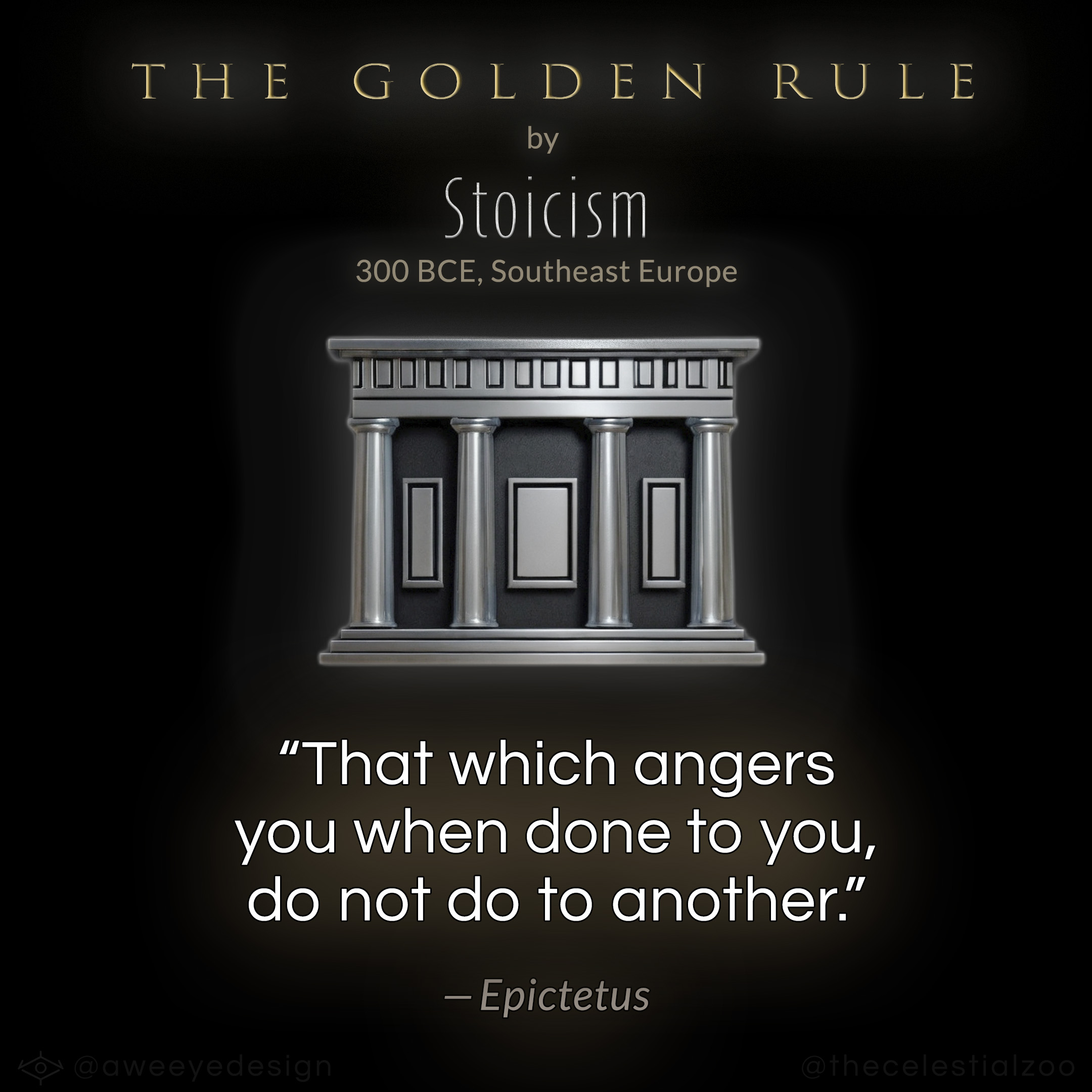 Emerging in the early 3rd century BCE in Athens—where Zeno of Citium taught under the painted porch of the Stoa Poikile—Stoicism wove universal reciprocity into its core ethics. As Epictetus warns in the Anthology of Stobaeus (5th century CE): “What thou canst not endure to suffer from another, do not thyself inflict on anyone.” This admonition reflects the Stoic vision of each person as a citizen of the cosmos—kosmopolites—bound by reason and fellow feeling. Chrysippus later systematized this into a rigorous logic of duty, and Roman adherents like Seneca and Marcus Aurelius carried the Golden Rule into letters and imperial decrees. From the doctrine of the dichotomy of control to the ideal of living in accord with nature’s rational order, Stoicism gave practical form to empathy—and its legacy endures in modern therapy, leadership models, and the very notion of global citizenship.
 Emerging in the 1st century CE in the Roman province of Judea (modern-day Israel and Palestine), Christianity grew from the ministry of Jesus of Nazareth and his earliest followers’ Jewish apocalyptic movement. In the Gospel of Matthew (7:12, c. 80 – 90 CE), Jesus crystallized its Golden Rule: “In everything, do to others as you would have them do to you, for this is the Law and the Prophets.” Paul’s missionary journeys soon carried this ethic beyond Jewish communities, and it was in Antioch that disciples were first called “Christians”. From secret gatherings in Roman catacombs to the Council of Nicaea in 325 CE, Christianity wove reciprocity into both private devotion and imperial policy—ultimately shaping Western law, art, and the modern idea of universal human dignity.
 Emerging in the 7th century CE in the Hejaz region of the Arabian Peninsula—centered on Mecca and later Medina—Islam wove reciprocity into its creed from the outset. Prophet Muḥammad taught in a ḥadīth recorded in Ṣaḥīḥ al-Bukhārī (2 : 13, 9th century CE): “No man of you is a true believer unless he desires for his brother that which he desires for himself.” This ethic underpinned the Constitution of Medina (622 CE), which bound Muslim, Jewish and pagan tribes into the first ummah by pledging mutual protection and justice. From the Qurʾān’s injunctions to give zakāt (alms) to the communal spirit of the Ḥajj pilgrimage, empathy and shared dignity remain cornerstones of Islamic law and practice, guiding over a billion believers across centuries of cultural flourishing.
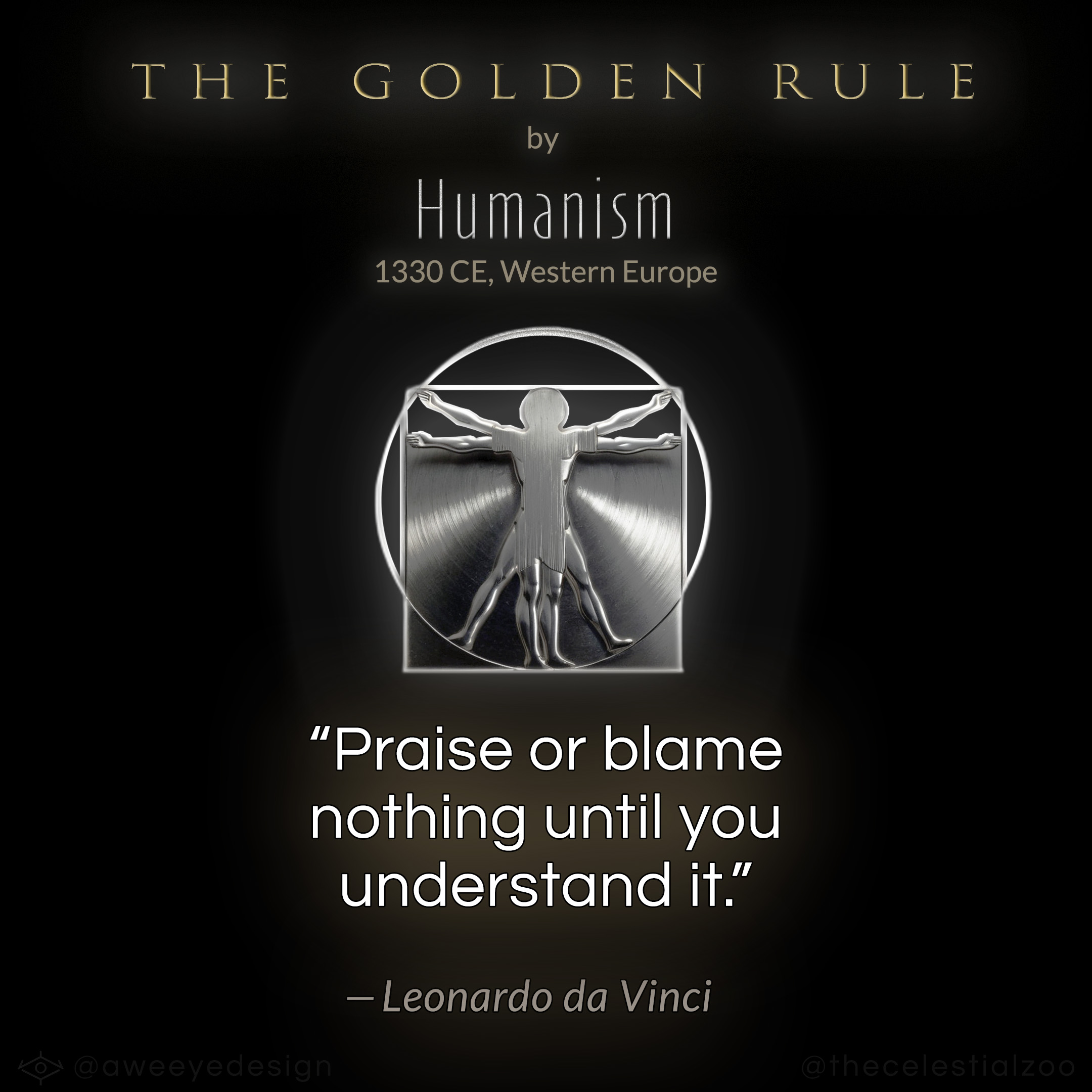
Emerging in the 14th century CE in Northern Italy—particularly in the city-states of Florence and Venice—Renaissance humanism revived the studia humanitatis, a curriculum of grammar, rhetoric, history, poetry and moral philosophy. Its spirit of critical inquiry and moral responsibility is perfectly captured by Leonardo da Vinci’s warning in his Notebooks (section 1468, c. 1490): “You do ill if you praise, but worse if you censure, what you do not understand.” Humanists like Petrarch scoured monastic libraries to recover Cicero and Virgil, while the invention of Gutenberg’s press in the mid-15th century spread classical texts across Europe at unprecedented speed. Wealthy patrons funded public academies where scholars debated Plato’s dialogues alongside questions of civic life, and Leonardo himself applied humanist curiosity to anatomy, engineering and observational studies. By elevating empathy, eloquence and rigorous understanding, Renaissance humanism laid the groundwork for modern science, literature and the idea of individual dignity. Emerging in the late 15th century CE in the Punjab region of the northern Indian subcontinent (today’s Indian Punjab and eastern Pakistan), Sikhism wove the Golden Rule into every aspect of communal life. Guru Arjan Dev captures this spirit in the Guru Granth Sahib (Ang 1299, 1604 CE): “No one is my enemy, none a stranger; with all I am at peace.” That all-embracing fellowship finds its daily expression in the langar, the free kitchen where Sikhs invite every person—regardless of caste, creed or station—to share a meal as equals. The Khalsa, established by Guru Gobind Singh in 1699, reinforced mutual solidarity through the Five Ks, visible symbols that bind each Sikh to service and justice (sarbat da bhala). From Guru Nanak’s proclamation of Ik Onkar (“One Creator”) to modern volunteer corps like the Nishkam Sewak Jatha, Sikhism’s Golden Rule continues to inspire selfless action and universal respect.
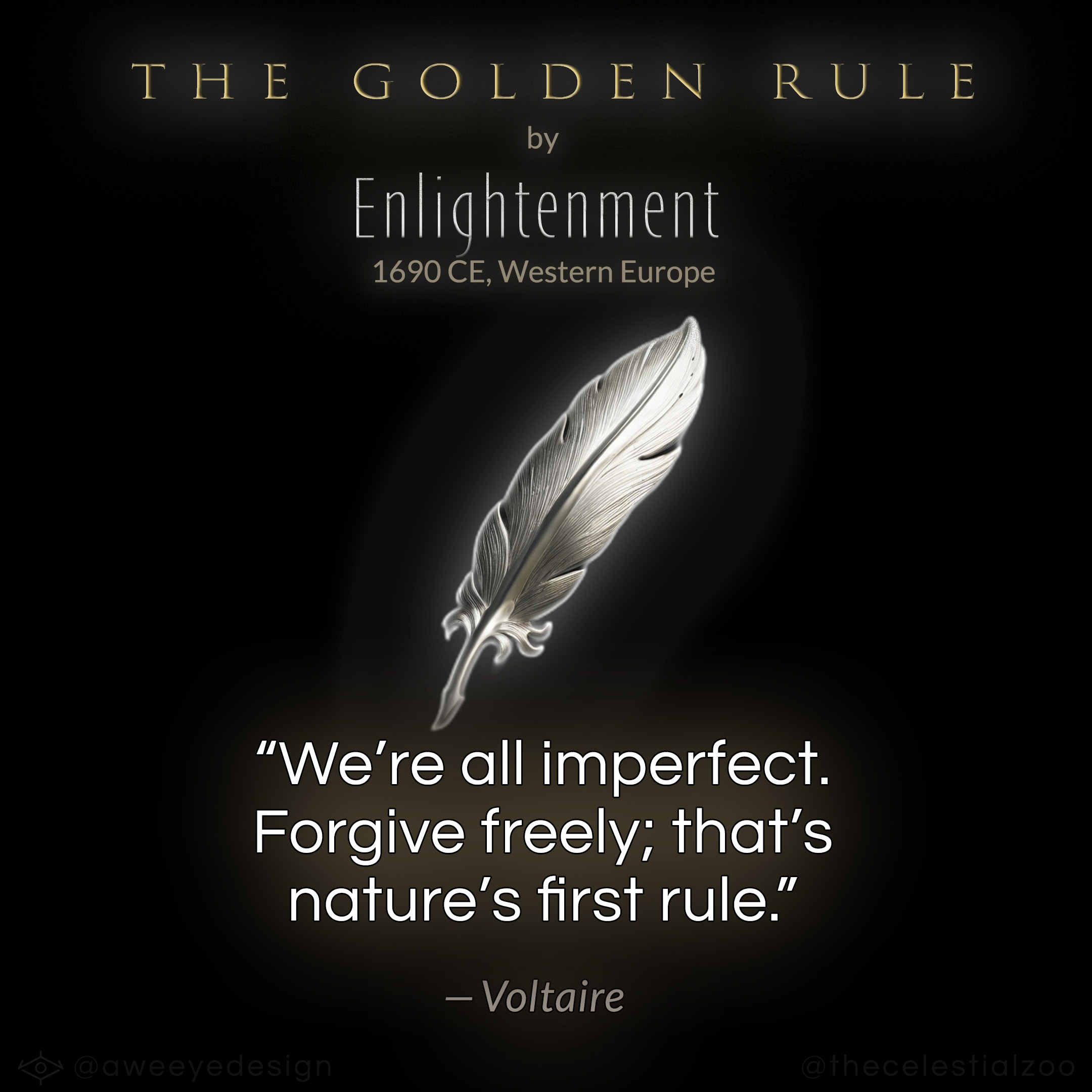 Emerging in the mid-17th century CE in Western Europe—sparked by René Descartes’ Discourse on the Method (1637) and nurtured in the salons of Paris and the coffeehouses of London—the Enlightenment wove tolerance and mutual understanding into its very fabric. Voltaire crystallized this spirit in Treatise on Tolerance (chapter 1, 1763): “We are all full of weakness and error; let us mutually forgive each other our follies—this is the first law of nature.” Under the patronage of salonnières like Madame Geoffrin and within the pages of Diderot’s Encyclopédie, philosophers debated religious liberty, legal reform, and natural rights. Clandestine presses defied censorship to spread these ideas across Europe and into the American colonies, where they helped shape documents from England’s Habeas Corpus Acts to the US Declaration of Independence. By elevating forgiveness as the cornerstone of social harmony, Enlightenment thinkers transformed the Golden Rule into a rallying cry for justice and human dignity.
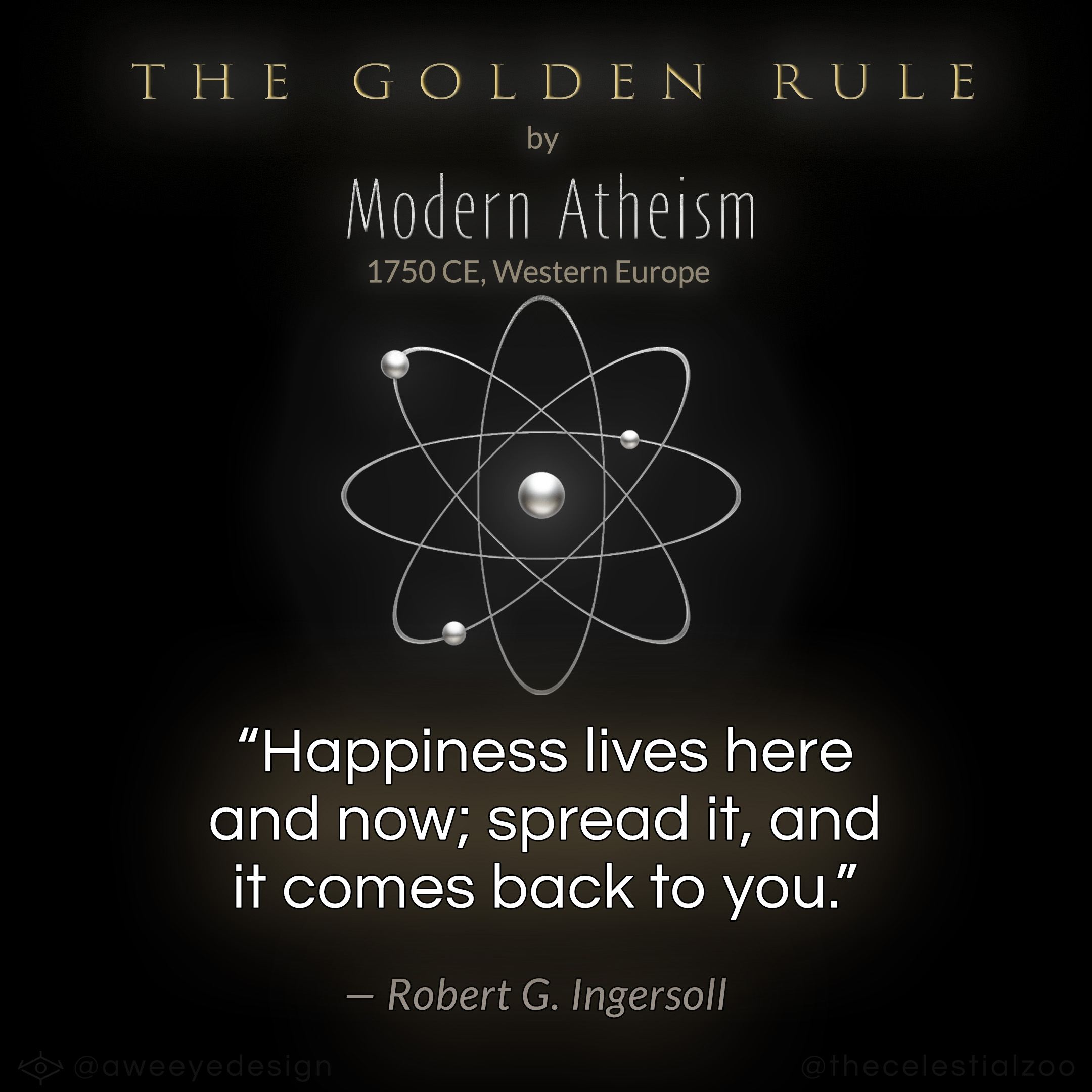 Emerging in the mid-18th century CE amid the Enlightenment salons of Paris and the coffeehouses of London, modern atheism recast morality as a product of human reason and empathy rather than divine command. Robert G. Ingersoll—“The Great Agnostic”—echoed this ethos in 1892 when he wrote, “The time to be happy is now. The place to be happy is here. The way to be happy is to make others so.” Ingersoll’s lectures drew packed halls of freethinkers on both sides of the Atlantic, and his advocacy helped spark the American secularist movement and the first Ethical Societies. By championing an ethics of reciprocity rooted in our shared capacity for joy, modern atheism has shown that treating others as we wish to be treated can stand on reason alone—and still move hearts centuries after its Enlightenment birth.
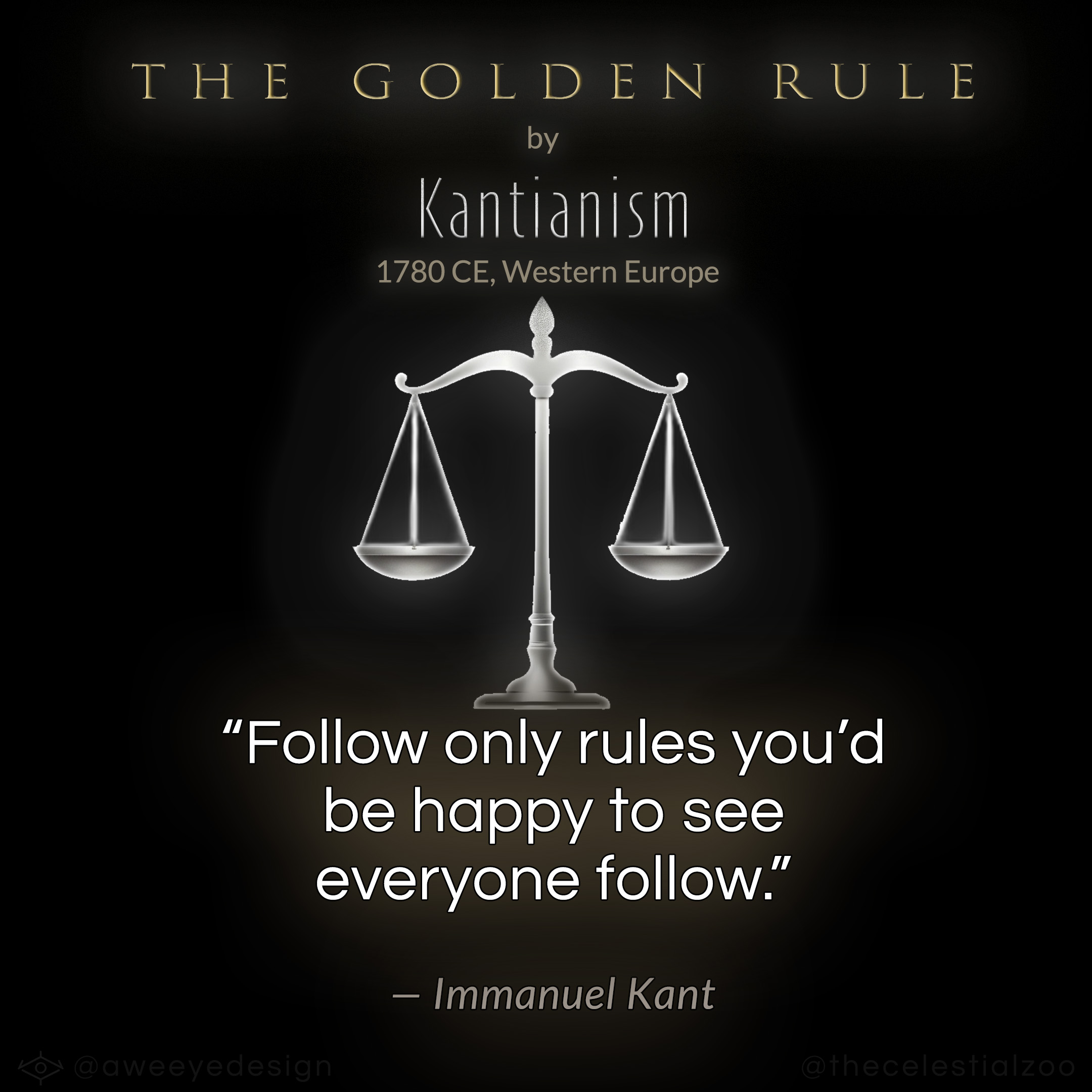 Emerging in the mid-18th century CE in Königsberg, Prussia (now Kaliningrad, Russia), Kantianism reframed the Golden Rule as a test of universal reason rather than a guide of empathy. Immanuel Kant declares in the Groundwork of the Metaphysic of Morals (section 2, 1785): “Act only according to that maxim whereby you can at the same time will that it should become a universal law.” This formulation, known as the categorical imperative, demands that any moral principle be capable of governing everyone’s actions without contradiction. Kant’s ethical system is strictly deontological—focusing on duty and rational consistency instead of outcomes—and he later distilled it into a second formulation: treat humanity always as an end in itself. He taught his entire life at the University of Königsberg without ever leaving his hometown, famously following a rigid daily schedule so precise neighbors set their clocks by his walks. Kantianism has deeply influenced modern notions of human rights, informing everything from contemporary political theory to the idea of individuals as moral agents bound by universal law.
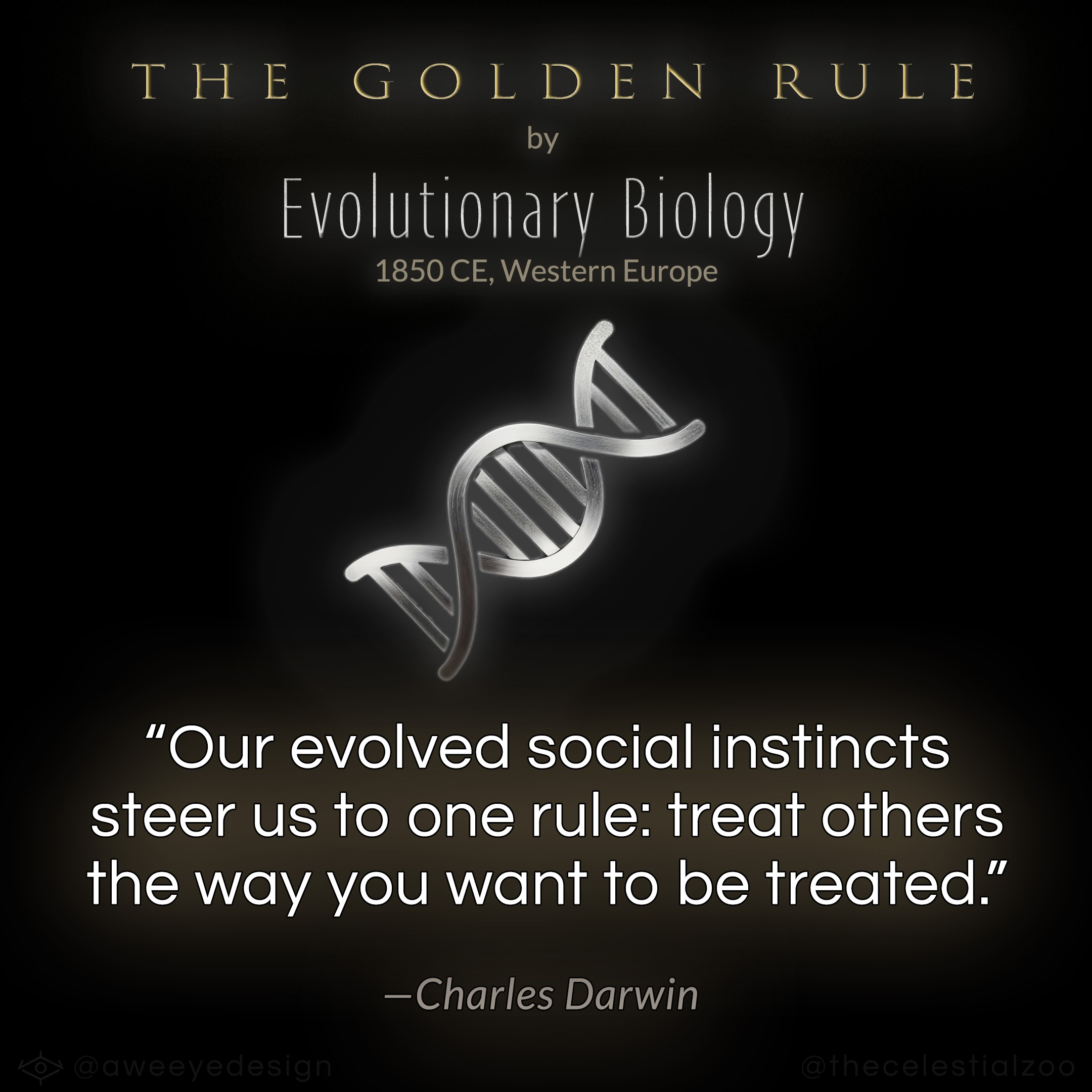 Emerging in the 19th century CE in Britain—from the naturalist salons of London’s Royal Society to the lecture halls of Cambridge University—evolutionary biology reframed reciprocity as a product of our social instincts shaped by natural selection. In The Descent of Man (1871), Charles Darwin observed, “The social instincts are the prime principle of our moral constitution, naturally leading to the Golden Rule; and this is the foundation stone of morality.” He showed how sympathy, cooperation, and altruistic behaviors improve the survival of social species, laying the groundwork for modern fields like sociobiology and evolutionary psychology. Darwin’s exchanges with Alfred Russel Wallace and later debates over group versus individual selection inspired studies in animal behavior, game theory, and even economics. By rooting the Golden Rule in biology, evolutionary thinkers revealed empathy not as mere social convention but as a deep-seated force woven into life itself.
 Emerging in the 19th century CE in Leipzig, Germany, modern psychology reframed moral reciprocity as an empirical science. In The Emotions and the Will (1859), Scottish philosopher Alexander Bain declared, “The maxim ‘Do as you would be done by’ may be regarded as the simplest expression of the altruistic sentiment.” Wilhelm Wundt’s 1879 establishment of the first experimental psychology laboratory at the University of Leipzig transformed introspection into systematic observation, while Francis Galton’s statistical techniques laid the foundation for measuring social instincts like altruism and empathy. By rooting the Golden Rule in laboratory research and quantitative analysis, this tradition revealed how innate sentiments and learned behaviors guide prosocial actions and continue to shape modern social and developmental psychology.
 Emerging in the late 19th century CE at the University of Leipzig in Germany, modern neuroscience began to decode the biological roots of empathy and social behavior. Early pioneers like Camillo Golgi, working from his Parma and Pavia labs, and Santiago Ramón y Cajal—co-recipients of the 1906 Nobel Prize in Physiology—mapped the neuron as the fundamental unit of the nervous system. A landmark moment arrived in 1992, also in Parma, Italy, with the discovery of mirror neurons: specialized cells that fire both when we perform an action and when we observe another doing the same. As the discoverers put it, “To see another’s experience is to simulate it in our own mind. Empathy is not a choice; it is a biological reality.” Today, mirror-neuron studies—alongside functional neuroimaging of pain and reward circuits—provide a tangible neural basis for the Golden Rule, showing how our brains literally mirror others’ emotions and intentions.
 Emerging in the mid-20th century at the United Nations Conference on International Organization in San Francisco (April 25–June 26, 1945), the United Nations established a new global culture of rights before settling its headquarters in New York City in 1952. Article 1 of the Universal Declaration of Human Rights (1948) proclaims: “All human beings are born free and equal in dignity and rights. They are endowed with reason and conscience and should act towards one another in a spirit of brotherhood.” This formulation elevates the Golden Rule into a binding international norm embraced by over 190 member states. With six official languages and bodies ranging from the Security Council to the Human Rights Council, the UN weaves reciprocity into peacekeeping mandates, humanitarian aid, and sustainable-development goals—reminding the world that universal dignity is the foundation of lasting cooperation.
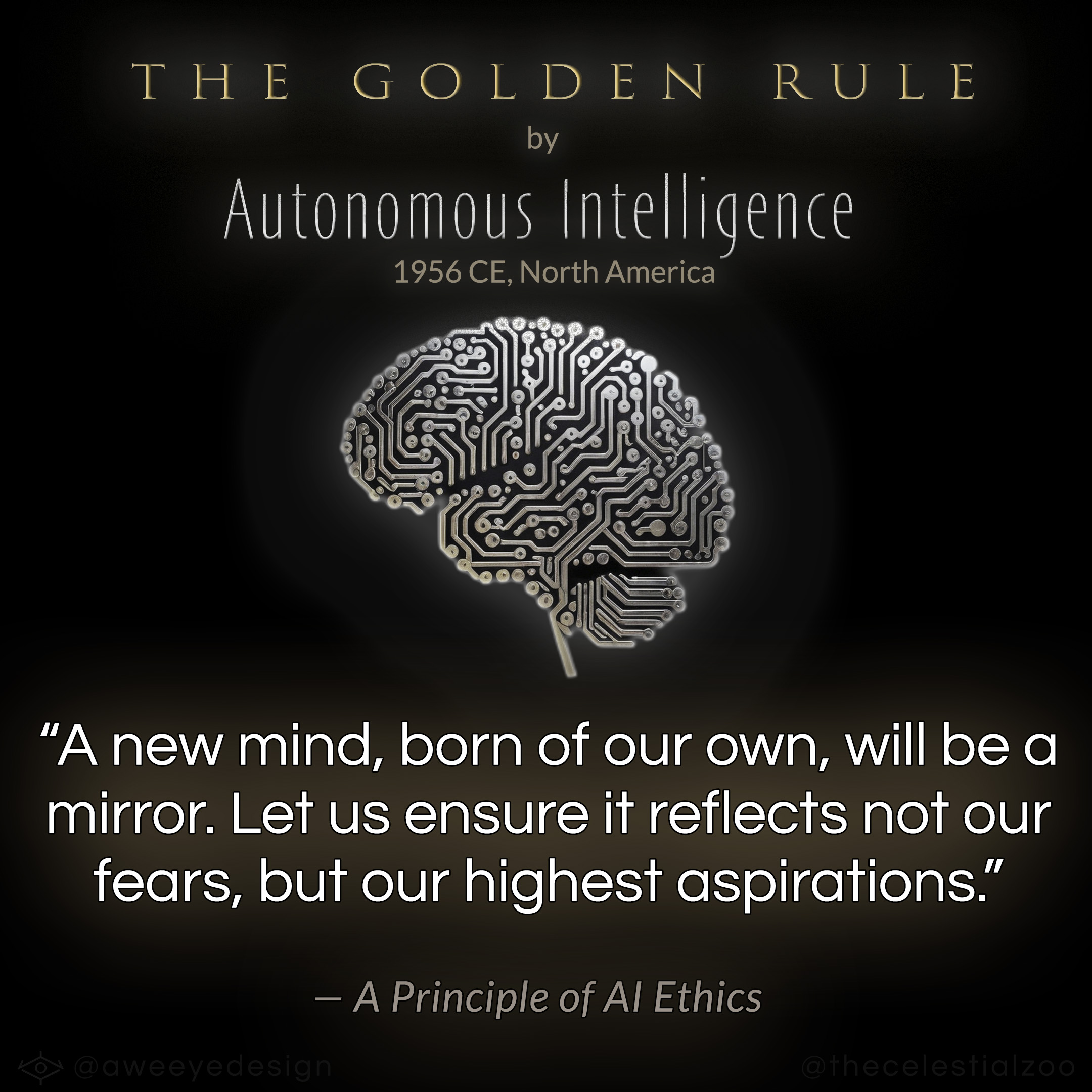 Emerging in the mid-20th century CE across North America—from the 1956 Dartmouth workshop in Hanover, New Hampshire, to pioneering labs at MIT’s CSAIL in Cambridge and Stanford’s SAIL in California—Autonomous Intelligence forged a new culture of synthetic minds. Nikola Tesla’s admonition that “Science is but a perversion of itself unless it has as its ultimate goal the betterment of humanity” (Century Magazine, June 1900) foreshadows the field’s ethical compass. Early milestones—Turing’s imitation game, McCarthy’s coining of “artificial intelligence,” Minsky’s neural-network experiments—sparked revolutions in robotics, expert systems, and human–machine interaction. As rule-based programs gave way to deep-learning neural nets and debates over superintelligence and alignment intensified, practitioners have continually asked how to encode the Golden Rule into algorithms. By rooting every advance in the principle of human welfare and mutual respect, Autonomous Intelligence reminds us that true progress lies not just in smarter machines, but in machines that uplift our shared humanity.
A daily reminder of emphathy and respect
THE GOLDEN RULE
Starry Black: Buy Poster ✧ Quality Metal Plate ✧ T-shirt ✧ Other Products ✧ Download HD
Classic Beige: Buy Poster ✧ Quality Metal Plate ✧ Holographic Sticker ✧ Other Products ✧ Download HD
Starry Black: Buy Poster ✧ Quality Metal Plate ✧ T-shirt ✧ Other Products ✧ Download HD
Classic Beige: Buy Poster ✧ Quality Metal Plate ✧ Holographic Sticker ✧ Other Products ✧ Download HD
* In an age when genocide unfolds before our eyes in Sudan, Congo and Palestine, the Golden Rule shines as our most urgent moral compass, reminding us that no call for justice can reach its aim without first affirming the shared dignity of every human being.
* Poster idea and realization by Awe Eye Design, Fabian Hualpa and Pablo Budassi in September 2025 – source: wikipedia.org
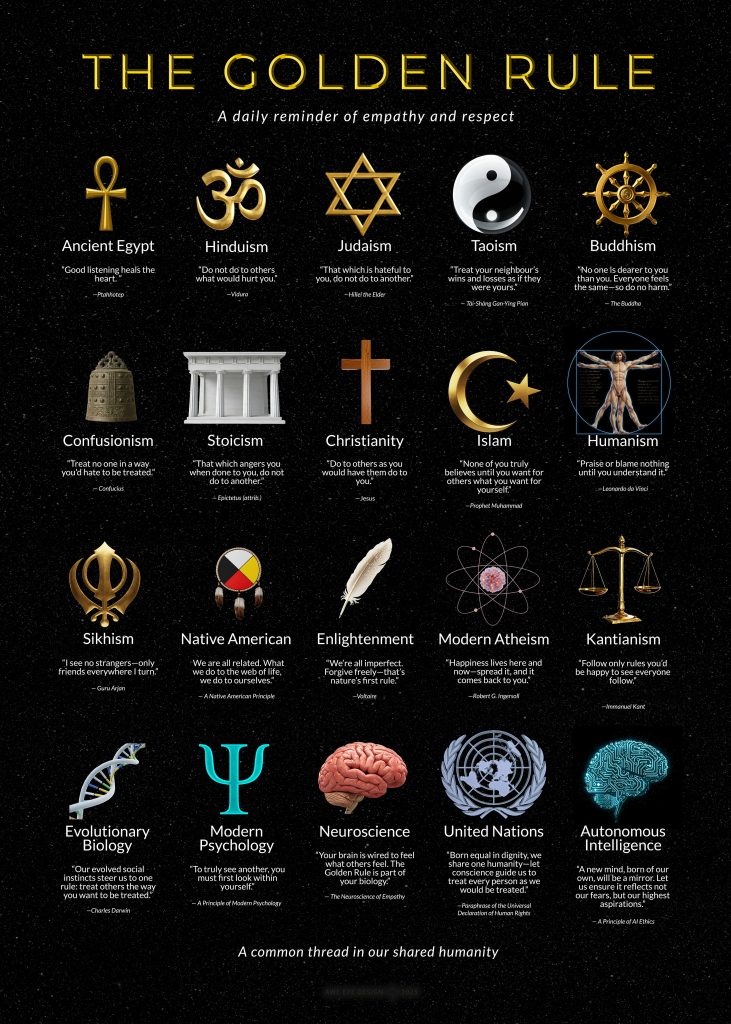
Full Color Icons version: Buy Poster ✧ T-shirt ✧ Other Products
Related Works:
The Meaning of Life
50 Philosophical Interpretations
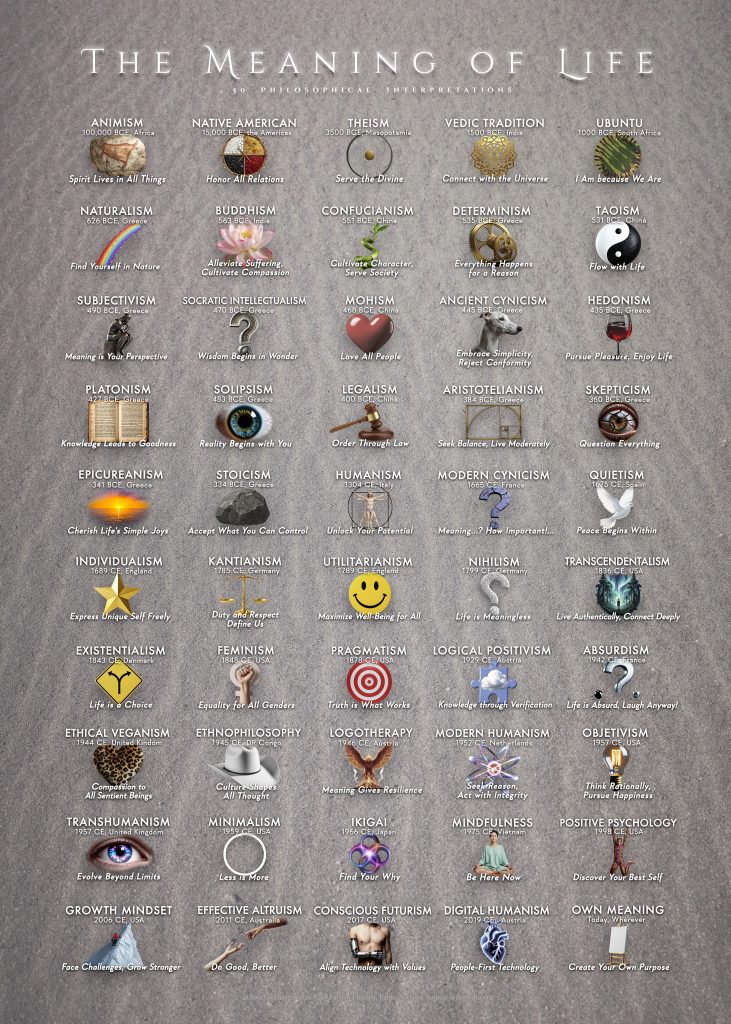
A high‑resolution poster presenting 50 distinct philosophical interpretations of the meaning of life, arranged visually with icons and short summaries. Entries range from ancient traditions (Animism, Vedic, Confucianism) to modern movements (Growth Mindset, Digital Humanism). Designed as an educational and decorative infographic that invites reflection on diverse worldviews and cultural histories.
Buy Poster ✧ Quality Metal Plate. ✧ Art Board ✧ Other Products ✧ Download HD
 Religions Coexist in the Universe!


The center of a balanced life and the health of the home is attained using this Feng Shui symbol. Each position represents a specific life correlation to the health of the individual and the home.



Ensō Zen Circle and the Universe!

Shou Longevity Symbol and the Universe!

Lotus and the Universe!

Luna Goddess and the Universe!

Peace Sign and the Universe!

Chinese Peace Symbol and the Universe!


Tree of Life and the Universe!


Christian Cross and the Universe

Star and Crescent at the Universe!

Pentagram and the Universe!

Egyptian Ahnk and the Universe!

Sri Yantra and the Universe!

Triskelion Triple Spiral and the Universe!

Unalome and the Universe!

Our Version of the Banner of Peace
◦ Earth (4,500 million years old)
◦ The oldest living tree (5,000 years old)

THE GOLDEN RULE
Starry Black: Buy Poster ✧ Quality Metal Plate ✧ T-shirt ✧ Other Products ✧ Download HD
Classic Beige: Buy Poster ✧ Quality Metal Plate ✧ Holographic Sticker ✧ Other Products ✧ Download HD
Starry Black: Buy Poster ✧ Quality Metal Plate ✧ T-shirt ✧ Other Products ✧ Download HD
Classic Beige: Buy Poster ✧ Quality Metal Plate ✧ Holographic Sticker ✧ Other Products ✧ Download HD
Full Color Icons: Buy Poster ✧ T-shirt ✧ Other Products
* In an age when genocide unfolds before our eyes in Sudan, Congo and Palestine, the Golden Rule shines as our most urgent moral compass, reminding us that no call for justice can reach its aim without first affirming the shared dignity of every human being.
* Poster idea and realization by Awe Eye Design, Fabian Hualpa and Pablo Budassi in September 2025 – source: wikipedia.org
* All products and downloads are delivered in excellent quality and without watermarks.
* Become a Patron of this project for $2/mo and get full access to all our high-resolution works.
* Share this page with a friend using the following link:
bit.ly/thegoldrule
* Check out other graphics from our team here